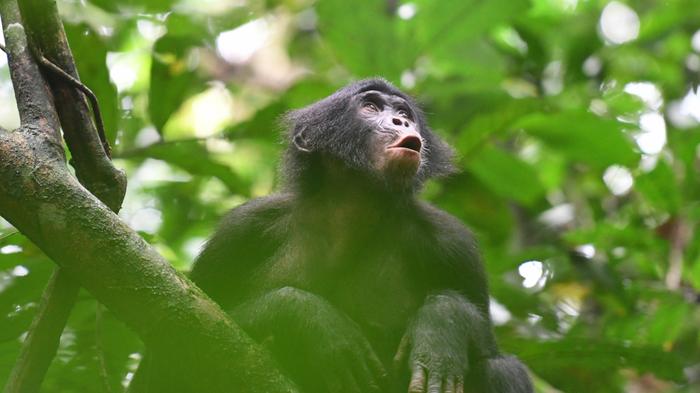
Recent research indicates a fascinating shift in how we view the boundary between human and animal communication.
If chimpanzees can indeed combine vocalizations in a way that generates new or more complex meanings — especially in a manner resembling compositional combination — it suggests that the roots of language go deeper in our evolutionary history than previously thought.
- Chimpanzees and Combinational Communication: The study suggests chimpanzees don't just use isolated calls but can combine them to create new meanings, similar to how humans string together words. This behavior may mirror the compositional combinations found in human language.
- Evolutionary Implications: If our primate relatives can structure sounds in a meaningful, flexible way, it provides strong evidence that the precursors to syntax and grammar might have existed before modern humans evolved. This pushes the timeline for the emergence of language-like communication further back in our evolutionary tree.
- Not Just Noise: Historically, animal calls were seen as mostly reflexive — signaling fear, aggression, mating readiness, etc. But this research underscores a growing recognition that animal communication may be more sophisticated, containing semantic and possibly syntactic structures.
- Limits Still Exist: While this is a significant step, it’s worth noting that chimpanzees’ abilities, as currently observed, still don’t approach the infinite generative capacity of human language. Their communication systems are context-bound and limited in complexity.
This kind of research helps bridge the gap between human uniqueness and our evolutionary roots. It challenges the idea that language suddenly "appeared" and instead supports a gradual evolution of communicative complexity, potentially beginning with shared ancestors of humans and apes.
When I was a young boy, and only spoke Spanish, my brothers and older cousins liked calling me Mono Viejo, which translates to Old Mokey. I guess everything happens for a reason.
In contrast, the calls of chimpanzees appear to be remarkably complex. Analyzing thousands of vocalizations from 53 wild chimps in the Taï National Park, Ivory Coast, researchers identified 12 single call types and 16 two-call combinations. A deeper investigation revealed that chimpanzees modify meaning in four distinct ways, using compositional and non-compositional combinations.
The first adds meaning: if A means “feeding” and B means “resting,” AB means “feeding and resting.” The second clarifies meaning: if A means “feeding or traveling” and B means “aggression,” AB means “traveling.” The third enables chimpanzees to conceive new meanings via non-compositional combinations: if A means “resting” and B means “affiliation,” AB means “nesting.” The fourth and final technique is the ordering effect, in which the sequence of the calls impacts their overall meaning, much like how the order of words affects the meaning of sentences.
“This changes the views of the last century, which considered communication in the great apes to be fixed and linked to emotional states,” Cédric Girard-Buttoz, first author on the study, said in a press release.
The discovery not only offers fascinating insight into the lives of these great apes but could help explain the development of human language. The researchers say the complex combinatorial abilities witnessed in chimps may have existed in the common ancestor we share.
“Such a system in nonhuman animals has never been documented and may be transitional between rudimentary systems and open-ended systems like human language,” the study authors write.
The findings reflect recent research analyzing the calls of bonobos, finding that they, too, can combine calls to create new meanings. As Girard-Buttoz points out, this suggests either “there is indeed something special about hominid communication” or “that we have underestimated the complexity of communication in other animals as well.”