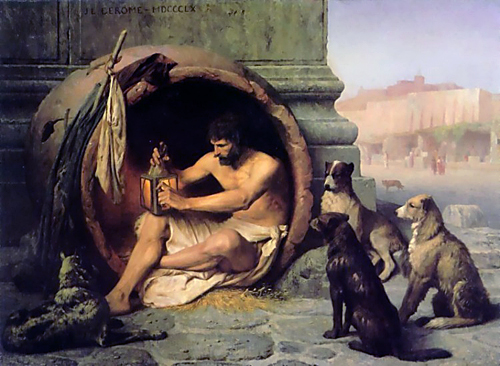
Diogenes was too irascible a character not to share some anecdotes about him from the compendium of Diogenes Laertius on the Lives of the Eminent Philosophers. They illustrate the precepts by which he lived: that personal happiness is satisfied by meeting one's natural needs and that what is natural cannot be shameful or indecent.
His life, therefore, was lived with extreme simplicity, inured to want and without shame. It was this determination to follow his own dictates and not adhere to the conventions of society that he was given the epithet "dog," from which the name "cynic" is derived. As to why he was called a dog, Diogenes replied, "Because I fawn upon those who give me anything, and bark at those who give me nothing, and bite the rogues." Sold as a slave, he pointed and said, "Sell me to this man; he needs a master." The man heeded the advice and entrusted Diogenes with his household and the education of his children.
Alexander the Great was reported to have said, "Had I not been Alexander, I should have liked to be Diogenes." Once, while Diogenes was sunning himself, Alexander came up to him and offered to grant him any request. "Stand out of my light," he replied. (There are many other references to this incident, principally Plutarch, Life of Alexander, XIV.1–5.) When asked why he went about with a lamp in broad daylight, Diogenes confessed, "I am looking for an honest man." Seeing a young man blush, he remarked that it was the complexion of virtue.