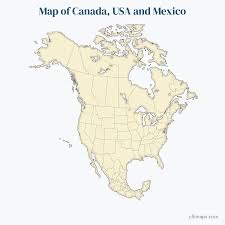
Public polling from the Pew Research Center) shows that global and regional favorability toward the U.S. varies widely.
While majorities or strong pluralities in many allied nations hold favorable views, approval ratings in neighboring countries like Mexico and Canada frequently fluctuate based on current political and economic tensions.
Canada: Created as a self-governing Dominion of the British Empire in 1867 through the British North America Act, with full constitutional sovereignty achieved later in 1982. [1, 2, 3, 4]
Mexico: Gained formal independence in 1821 after the end of Spanish rule, though the land has thousands of years of deep-rooted Indigenous and pre-Columbian history (such as the Olmec, Maya, and Mexica civilizations).
The United States shares at least 57 lakes and reservoirs with Canada, but only two major international reservoirs with Mexico. [1, 2, 3]
The U.S. and Canada Border
The U.S. and Canada share the longest international border in the world, with a heavy concentration of shared water bodies: [1]
- The Great Lakes: The boundary divides four of the five Great Lakes—Lake Superior, Lake Huron, Lake Erie, and Lake Ontario. Lake Michigan sits entirely within the United States. [1]
- Other Major Lakes: Massive boundary lakes include Lake of the Woods (spanning Minnesota, Ontario, and Manitoba) and Lake Champlain (between New York, Vermont, and Quebec). [1]
- The Remainder: The rest of the tally is composed of dozens of smaller lakes and reservoirs primarily concentrated along the Ontario-Minnesota border and the Maine-New Brunswick border. [1]
The U.S. and Mexico Border
Because the southern border is mostly defined by the arid landscape of the Rio Grande, the U.S. does not share any natural major lakes with Mexico. Instead, they share two massive, man-made reservoirs built along the river for flood control and irrigation: [1, 2, 3]