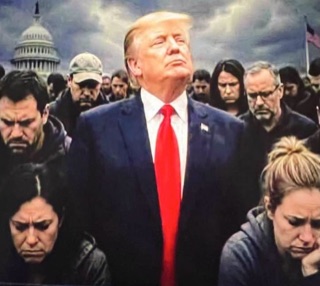
There's something extremely serious happening in American politics The answer is that this is contested terrain between people who see a party being radicalized from within, and people who see normal, ideological evolution being mischaracterized as crisis. The midterms this November will be one real data point either way. What do you say? Register and #VOTE to have your say on election day.
Weighed competing narratives about #GOP transformation and institutional resilience
The answer is that this is genuinely contested terrain, between people who see a party being radicalized from within, and people who see normal, even successful, ideological evolution being mischaracterized as crisis by opponents. The midterms this November will be one real data point either way.
As a former official for a previous GOP #POTUS and a lifelong #NPA, (No Political Affiliation) this is real debate, and the premise has competing answers depending on who you ask. So to be balanced, let me lay out both sides rather than just choosing one.
There's real evidence of strain. Analysts at Brookings and others tracking the 2026 primaries point to a clear split between the "MAGA wing" and "more traditional conservatives" Trump-backed challengers ousted seven incumbent Indiana state senators who'd resisted his redistricting push, and similar tests are playing out in Kentucky, Texas, and Georgia. Several major outlets reported on a "rift" within the party tied to a growing cohort of anti-Jewish rhetoric and a debate over how expansive the party's coalition should be, which Trump himself eventually pushed back on while Vance had been more reluctant to. Polling research (e.g., the Manhattan Institute's "New GOP" survey) describes a coalition split between a stable "Core" Republican base and a newer, younger "New Entrant" bloc, more conspiratorial, more tolerant of extreme rhetoric, less reliably loyal to the party itself rather than to Trump personally. That's a real structural question: does the coalition hold together once Trump is gone?
On the other hand, by most conventional metrics the GOP isn't weak, it currently holds the presidency, both chambers of Congress, most governorships and state legislatures, and a Supreme Court majority. That's not what institutional collapse usually looks like. Party-faction fights (establishment vs. Tea Party, Reagan-era purges of moderates, etc.) are a recurring feature of American party history, not a new phenomenon, pundits have declared the GOP in "existential crisis" repeatedly since 2016, and it has kept winning elections. Many conservatives would also push back hard on the word "extremist" itself, arguing it's a politically loaded label Democrats and media use to delegitimize policy positions (immigration enforcement, tariffs, judicial appointments) that are simply more nationalist/populist than the older Buckley-style fusionist conservatism, not inherently dangerous. From this view, what's happening is a generational realignment, not a death spiral, similar to how the New Deal coalition or the Goldwater-to-Reagan shift transformed a party without ending it.
How some think the GOP "survives"
- Succession planning: Much of the conversation centers on whether Vance, Ramaswamy, or other Trump-aligned figures can inherit the coalition's energy without Trump himself, versus whether it fragments without him as the unifying figure.
- Economic focus: House GOP leadership has explicitly pivoted 2026 messaging toward affordability and cost-of-living, betting that bread-and-butter issues outlast culture-war turbulence.
- Demographic strategy: Some point to Trump's 2024 gains with Hispanic and working-class voters as evidence the party is broadening, not narrowing.
- Institutional insulation: Control of courts, state legislatures, and redistricting gives the party tools to weather a rough midterm cycle even if it loses ground nationally.
- A "purge or split" scenario: Others argue real fracture is still possible, if #MAGA candidates underperform in November and traditional conservatives reassert control, or alternatively if anti-establishment energy keeps winning primaries and pushes moderates out entirely.