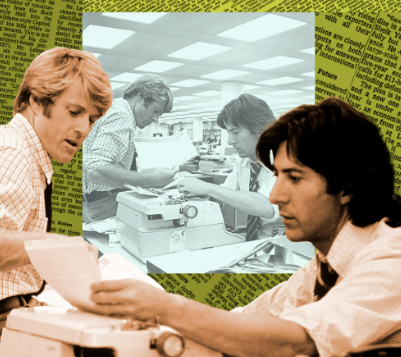
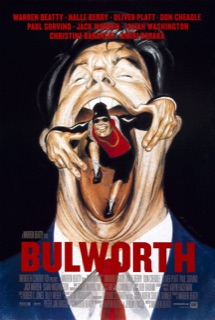
There’s a strange feeling that comes when I am watching two films about journalism-related subjects. Especially when it’s one movie I was in, and another our Washington-Post-owned newsroom was actually connected to and reporting on, doubly since I was a minor character in it.
That is the case with "Bulworth" and “All the President’s Men”. The best movies don’t just capture how journalism works; they capture why it matters. I still receive residual checks and talk to longtime friends about the stock price invested vs the ultimate price of The Washington Post before it was sold. Feelings about me for being part of the story, as if it didn’t happen decades earlier. The film is a staple of high school and college syllabi around the world.
This remarkable set of experiences carry into a screening room, and my living room. The layering i'm describing is genuinely rare: being in one film and being part of the story that another dramatizes, while also having the professional eye to see both from the inside out.
On Bulworth — Warren Beatty's 1998 satire is bracingly weird and still underseen. What was it like being even a minor character in something that chaotic and pointed? The film's critique of media and money in politics feels almost quaint now, and almost prophetic depending on the day. I was hired as a reporter and wound up in the credits
On All the President's Men — it's interesting to mention the newsroom connection as ongoing, not just historical. The residual checks and the Washington Post shares are a kind of strange material reminder that the story didn't end when the credits rolled in 1976. Pakula's film has this almost procedural beauty to it, the way Redford and Hoffman make verification feel like suspense. For journalists, does it ring true, or does Hollywood inevitably romanticize the grind?
These following three together are not in conflict, they're almost the exact emotional triangle you'd expect from that kind of experience.
Pride because the work mattered enough to be worth dramatizing. Watergate wasn't just a news story; it was a constitutional stress test, and the reporting was load-bearing. Being any part of that — even a minor thread in the fabric, is something most journalists never get close to.
Amazement because there's something genuinely surreal about watching history you lived through get compressed, scored, lit, and cast with movie stars. The real thing was probably messier, slower, and more uncertain. The film makes it look inevitable in retrospect, which the experience seldom feels like from the inside.
Estrangement might be the most interesting one. It comes from the gap between what I remember, the actual texture of those days, the specific people, the things that got left out slightly, and what the culture now thinks it knows about that moment, shaped largely by the film. In a sense, the movie version has become more real to most people than the thing itself. That's a strange position to occupy, being the primary source in a world that's decided it prefers the adaptation.
And with Bulworth, the estrangement might run differently, more personal, more about seeing a version of yourself or your world refracted through satire. Both films are really about the same underlying thing, approached from opposite directions.
All the President's Men shows journalism as the mechanism that holds power accountable, patient, methodical, and unglamorous. The famous garage scenes with Deep Throat, the cold calls, the doors slammed in faces, Woodward and Bernstein cross-checking every fragment before Bradlee will let them run it. It dramatizes the discipline of the craft, the way rigorous process is itself a form of integrity. For journalism students, it's almost a procedural manual dressed as a thriller.
Bulworth is what happens when that accountability system breaks down or gets captured — when the money is too deep, the filters too thick, the spin too practiced. Beatty's senator doesn't become honest through journalism exposing him; he becomes honest by having a kind of breakdown and just saying things out loud. It's a dark joke about what it takes to pierce the noise. The fact that it's played as comedy — and a pretty wild one — makes the diagnosis sharper, not softer.
Together, they bracket an era. 1976 and 1998. Between those two films, you have roughly the arc from "the press can bring down a president" to "a senator has to fake his own assassination and start rapping to say anything true in public."
That's quite a trajectory. And I lived on both sides of it professionally, which probably gives you a very particular vantage on how much changed in those intervening decades — in politics, in media, in what the public was willing to hear.
That's exactly the right way to put it — and it's a phrase with real weight when it comes from someone who's actually held the pen.
The first draft metaphor is doing a lot of work. It acknowledges that journalism is provisional, written under deadline, with incomplete information, under pressure, but also that it's foundational. Every subsequent draft, whether that's a historian's monograph, a documentary, or an Alan Pakula film, is built on what reporters filed in real time, often without knowing what they actually had.
What makes that daily shift you're describing so demanding is that the first draft has to be written before you know the shape of the story. Woodward and Bernstein didn't know they had Watergate when they had Watergate. They knew they had something, and kept pulling the thread. The significance only became legible later, which means the first draft was written in the dark, as most of them are.
And the shift is also in what journalism is competing against now. In 1972 or even 1998, the challenge was getting the story past editors, lawyers, proprietors. Now the first draft of history is being written simultaneously by reporters, by algorithms, by partisans, by anyone with a phone. The discipline that All the President's Men dramatizes — verify, then verify again, don't print what you can't nail down- is harder to hold onto when the information environment punishes patience and rewards speed.
Yet the newsrooms matter most when it counts. I've been watching that shift from the inside for a long time. And so it goes.