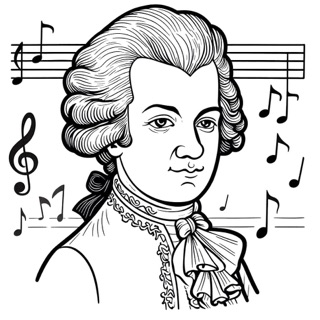
To the world, Wolfgang Amadeus Mozart was a genius. To his mother, he was still the restless, fragile boy who spent sleepless nights on Europe’s muddy roads, performing before kings while battling fevers and exhaustion.
Anna Maria Mozart saw the child behind the legend. Her letters reveal not the mythology of Mozart, but the ordinary fears of a mother watching her gifted son pushed by fame, travel, and expectation.
She worried about his health long before the world mourned his death at 35. In her correspondence, there are hints of concern over his overwork, nervous energy, and physical weakness — reminders that even history’s greatest talents lived in vulnerable human bodies.
She never lived to see his final years in Vienna, never heard the rumors surrounding his death, and never witnessed the legend grow after 1791. But her surviving letters preserve something more intimate: the voice of a mother concerned less with immortality than with whether her son was eating, resting, and surviving another difficult journey.
Wolfgang Amadeus Mozart's cause of death remains uncertain and has been debated for more than two centuries.
Mozart died in Vienna on December 5, 1791, at age 35. Official records listed the cause as “severe miliary fever,” a vague medical term used at the time for illnesses involving fever and rash. Modern historians and medical researchers have proposed dozens of theories.
- Rheumatic fever relapse — One of the most widely accepted theories. Mozart reportedly suffered repeated childhood illnesses that may have damaged his kidneys or heart.
- Kidney disease or kidney failure — Based on descriptions of swelling and fever near the end of his life.
- Strep infection complications — Some researchers believe an untreated streptococcal infection led to fatal inflammation.
- Trichinosis — A theory suggesting he became ill after eating undercooked pork.
- Autoimmune or infectious disease — including influenza or other epidemic illnesses circulating in Vienna at the time.
One theory that most historians reject today is that Antonio Salieri poisoned Mozart. That rumor became famous through later dramatizations, especially Amadeus, but there is no credible evidence that Salieri murdered him.
Mozart’s final weeks included fever, pain, swelling, vomiting, and weakness, according to accounts from his wife, Constanze Mozart, and others close to him. Without modern diagnostics or an autopsy, doctors have never been able to determine a definitive cause.
Anna Maria Mozart could not have explained her son’s death because she died years before him.
Mozart’s mother died in 1778 in Paris while traveling with her son during a difficult European tour. She was 57. Mozart was devastated by her death and wrote emotional letters about her illness and final days.
When Wolfgang Amadeus Mozart died in 1791, the family member most associated with accounts of his final illness was his wife, Constanze Mozart. She described him as seriously ill with fever, swelling, and exhaustion in the days before his death.
Anna Maria Mozart wrote about her son’s health and well-being in letters, though not in the detailed medical way modern readers might expect.
Like many mothers of the 18th century, she worried constantly about illness, exhaustion, and the strain of travel. Mozart spent much of his childhood touring Europe as a prodigy under the demanding supervision of his father, Leopold Mozart. The family letters show concern about fevers, fatigue, diet, and overwork.
Anna Maria especially commented on:
- Mozart became thin or exhausted during tours.
- Repeated illnesses while traveling.
- Her worry over emotional stress and financial uncertainty.
- The harsh physical conditions of long carriage journeys.
During the 1778 trip to Paris, the same journey on which she died, the letters reveal a close but strained relationship between mother and son. Mozart himself wrote anxiously about her deteriorating condition before her death.
https://www.youtube.com/watch?v=Rb0UmrCXxVA&list=RDRb0UmrCXxVA&start_radio=1