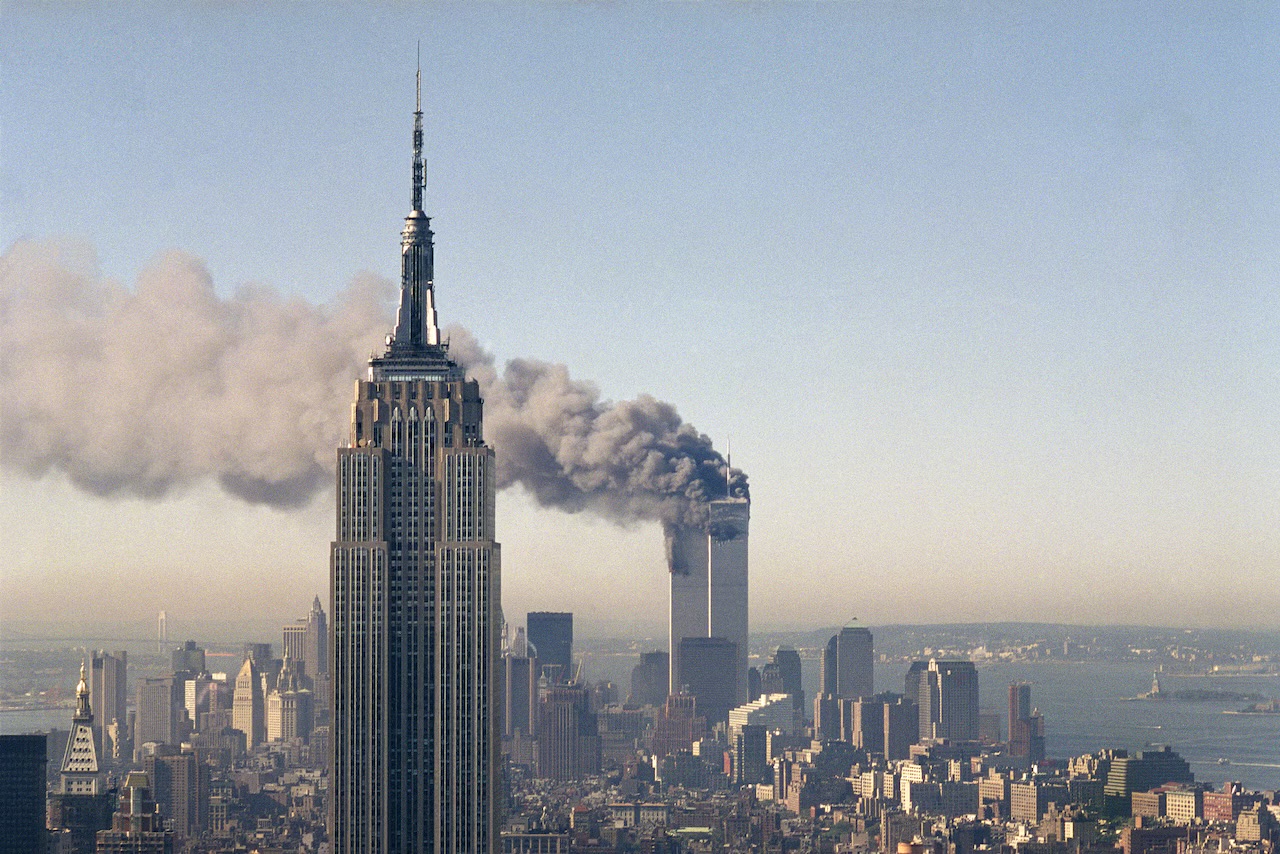
It has now been twenty five years and many more tears for the lives lost on that fateful day in New York City and my fears the answers fade away. Our Newsroom Never Stopped.
Twenty-five years ago, I woke up expecting another beautiful fall morning in New York City.
By the end of that day, the skyline I knew would be gone, thousands of people would be dead, and the world would be watching New York through television screens.
I was the New York bureau chief for Associated Press Television News, APTN. Our bureau was part of a worldwide television news operation serving more than 350 broadcasters. We provided news coverage, camera crews, editing, satellite distribution and other services to broadcasters and commercial clients around the world.
Then a commercial airliner hit the World Trade Center.
And then another.
There are moments when a journalist instinctively understands that the story being witnessed will define a generation.
This was one of them.
The shock lasted only moments. Then the newsroom went into motion.
Phones rang relentlessly. Clients around the world wanted information, pictures and video. They needed live feeds. They needed reporters and camera crews. They needed editors and satellite distribution. They needed people on the ground.
They needed New York.
And we had to deliver it.
There was no playbook for covering an attack of this magnitude on our own city. No manual explained how to simultaneously manage a global television news operation while watching your hometown disappear behind a cloud of smoke and ash.
So we did what journalists do.
We worked…. And worked… And worked.
Sleep became a luxury. Meals became an afterthought. The phones never seemed to stop ringing. Every available resource was pushed toward the story.
But somewhere between the assignments, satellite feeds and frantic calls, the enormity of what was happening became impossible to ignore.
This wasn't simply another breaking-news story.
People were dying.
Firefighters and police officers were running toward the destruction while civilians were running away.
Families were desperately trying to locate loved ones.
Hospitals were preparing for casualties.
Lower Manhattan was covered in smoke, ash and confusion.
And journalists were trying to make sense of it all while documenting history for a world that was watching.
That is the strange burden of journalism.
You must remain focused enough to tell the story while human enough to understand that the story is about real people.
Twenty-five years later, I still remember the images.
I remember the smoke, the sirens the uncertainty, the exhaustion.
Most of all, I remember the people who went to work that morning and never came home.
The first responders who gave their lives trying to save strangers.
The families who waited for phone calls that never came.
The survivors who carried Sept. 11 with them long after the television cameras left.
And the journalists who spent days telling the world what had happened while trying to comprehend it themselves.
Sept. 11 changed journalism, but it also changed the meaning of journalism for many of us.
We weren't covering history from a comfortable distance.
We were living inside it. Twenty-five years is a long time.
For some people today, Sept. 11 is a chapter in a history book. For those who were there, it remains a memory that can return without warning.
A photograph… A sound, the smell in the air..
A particular September morning.
And suddenly, back in New York, in the newsroom with the phones ringing. Back to the television screens.
Back to that terrible realization that the city you love has been attacked.
The calendar says 25 years have passed.
Memory says otherwise.
We owe it to the nearly 3,000 people who were killed that day to remember them as more than a number.
They were parents and children.
Brothers and sisters… Husbands and wives… Friends and colleagues.
New Yorkers… Americans and World Citizens that forever changed on a September morning.
We also owe something to the first responders who ran toward danger when everyone else was trying to escape.
And we owe something to the journalists who documented what happened, often under extraordinary circumstances, because the world needed to know.
That was our responsibility then. It remains our responsibility now.
Tell the truth. Preserve the record. Remember the dead.
Twenty-five years later, the tears have not completely dried.
The memories have not disappeared. And they shouldn't. Because forgetting is not healing. Remembering is.
I will never forget Sept. 11, 2001. New York, America, or the world must never forget and teach future generations.