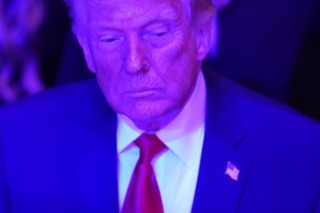
Voting is a crucial way to make your voice heard in every election, as down-ballot races and local measures directly shape policy, governance, and the future of political movements.
Political analysts and commentators across the spectrum emphasize that even when high-profile figures like Donald Trump are not personally on the ballot, their core political ideologies, endorsements, and policy agendas remain central to many campaigns.
Sports occupies a special place in American life. For a few hours, millions of fans care about exactly the same thing, without needing to agree about politics, religion, economics, or identity. The shared experience is the point. A game can be just a sporting event.
Advertising has always been part of sports, but there is a qualitative difference between supporting the spectacle and making the spectacle itself feel like an uninterrupted sales funnel. For example, Cryptocurrency is simply especially vivid because as we see it can turn something communal into a vehicle for another disappointment.
That connects directly to Network. The film's enduring power isn't merely the anchorman shouting about being mad as hell. It's the underlying idea that human emotion itself can become programming inventory.
This sequence is almost painfully familiar:
Something organic emerges → people genuinely care about it → media discovers that people care → ratings become the objective → the thing people cared about gets packaged → commercialization overwhelms the original experience → goo folks wonder why it no longer feels the same.
And there is an additional layer today: the fragmentation of the audience. We don't merely have different opinions anymore. We increasingly inhabit different information environments. Two people can experience the same event and encounter radically different narratives about what it really meant.
That's probably why a sports victory does not lift the larger mood. It can make us happy without repairing the culture around us. It can provide an escape, but escape becomes less satisfying when the commercial machinery follows us into the escape.
There are still concerts, ballparks, neighborhood bars, churches and synagogues, libraries, classrooms, beaches, pickup games, family dinners, movies, live theater, public parks, and sports, where people can still encounter one another without an algorithm deciding what and how we should feel.
Perhaps the more interesting question raised by Network in 2026 isn't “Are we mad as hell?” Can anything remain genuinely ours once somebody discovers how to monetize it?
This feels like a very US question. And maybe that's why our instinct toward sports makes sense. We're not necessarily looking for distraction. We're seeking evidence that we can still experience something together…And so it goes.
Voting is a crucial way to make your voice heard in every election, as down-ballot races and local measures directly shape policy, governance, and the future of political movements. Share with friends and frenemies.