The following are the many times US presidents shaded reality as they shaped American political history.
The following qualify as multiple misleading statements, deceptions outright falsehoods, or worse for democracy.
Presidents have long used words to inspire and shape the course of American history, from George Washington’s Farewell Address to Abraham Lincoln’s Gettysburg Address and John F. Kennedy’s call to “ask what you can do for your country.”
Presidential words have also influenced history in less admirable ways, including through false or misleading statements that altered public understanding of major events.
As the nation marks its 250th anniversary, we asked: What if PolitiFact, founded in 2007, had existed throughout American history? Which presidential claims might have warranted fact-checking?
Interviews with presidential historians revealed recurring examples of presidents stretching the truth, misleading the public or making false statements that helped justify wars or obscure domestic controversies.
The result is a collection of 11 examples in which presidents were less than candid with the American people, often with significant consequences.
In many cases, the historical record makes definitive conclusions difficult. It is often impossible to prove whether a statement was a deliberate falsehood a term #PolitiFact generally avoids using.
Sometimes presidents repeated inaccurate information provided by advisers. In other cases, the facts were uncertain at the time, or presidents presented information in the most favorable light. Some created misleading impressions through omission rather than direct statements. And in at least one instance, the debate hinged on “what the definition of ‘is’ is.”
With this in mind, here is a chronological look at presidential statements, omissions and deceptions that shaped the nation's history — and, in some cases, its trust in government.
The examples vary in severity and intent. Some involved claims later shown to be false. Others relied on selective presentations of facts, omissions or assertions made despite significant evidence to the contrary. Together, they illustrate a recurring challenge throughout American history: the tension between presidential persuasion and presidential truthfulness.
Jackson and the treaty behind the Trail of Tears
One of the nation's darkest chapters followed President Andrew Jackson's support for the 1835 Treaty of New Echota, which ceded Cherokee lands east of the Mississippi River and paved the way for the forced removal known as the Trail of Tears.
Jackson publicly portrayed the treaty as a legitimate agreement with the Cherokee Nation. But the document had been signed by a small faction of Cherokees rather than the tribe's elected leadership. Principal Chief John Ross and thousands of Cherokee citizens opposed it.
Historians say Jackson failed to acknowledge that reality when presenting the treaty to the public. The resulting removal campaign led to the deaths of thousands of Native Americans.
Polk's case for war with Mexico
In 1846, President James K. Polk told Congress that Mexico had "shed the blood of our fellow-citizens on our own soil," helping build support for the Mexican-American War.
The statement omitted a key fact: The clash occurred in territory claimed by both Mexico and Texas. Polk had ordered U.S. troops into the disputed area months earlier.
Critics at the time, including future President Abraham Lincoln, challenged Polk's characterization. Historians continue to cite the episode as a classic example of a president framing contested facts to justify military action.
McKinley, the Maine and war fever
After the USS Maine exploded in Havana Harbor in 1898, President William McKinley pointed to the disaster as evidence that conditions under Spanish rule in Cuba had become intolerable.
Although McKinley never directly claimed Spain had deliberately destroyed the ship, his administration capitalized on public outrage and growing demands for intervention. Later investigations suggested the explosion was most likely accidental rather than the result of a Spanish attack.
The sinking became the catalyst for the Spanish-American War.
Truman and Hiroshima
Announcing the atomic bombing of Hiroshima in August 1945, President Harry Truman described the target as "a military base."
Hiroshima did contain military facilities and served as an important command center. But the city was also home to a large civilian population, and most of the tens of thousands killed were civilians.
Historians continue to debate how much Truman knew about the target's demographics and whether the description reflected wartime messaging rather than deliberate deception.
Eisenhower and the U-2 incident
In May 1960, after a U.S. spy plane was shot down over the Soviet Union, the Eisenhower administration claimed the aircraft was conducting weather research.
The explanation collapsed when Soviet authorities revealed that pilot Francis Gary Powers had survived and that much of the aircraft had been recovered intact.
The incident embarrassed the administration and disrupted U.S.-Soviet relations at a critical moment in the Cold War.
Johnson and the Gulf of Tonkin
President Lyndon B. Johnson relied on reports of attacks against U.S. naval vessels in the Gulf of Tonkin to secure congressional approval for expanded military action in Vietnam.
Subsequent investigations found that one of the reported attacks almost certainly never occurred. Historians have concluded that administration officials presented the evidence with greater certainty than the facts justified.
The Gulf of Tonkin Resolution became a turning point in deepening U.S. involvement in Vietnam.
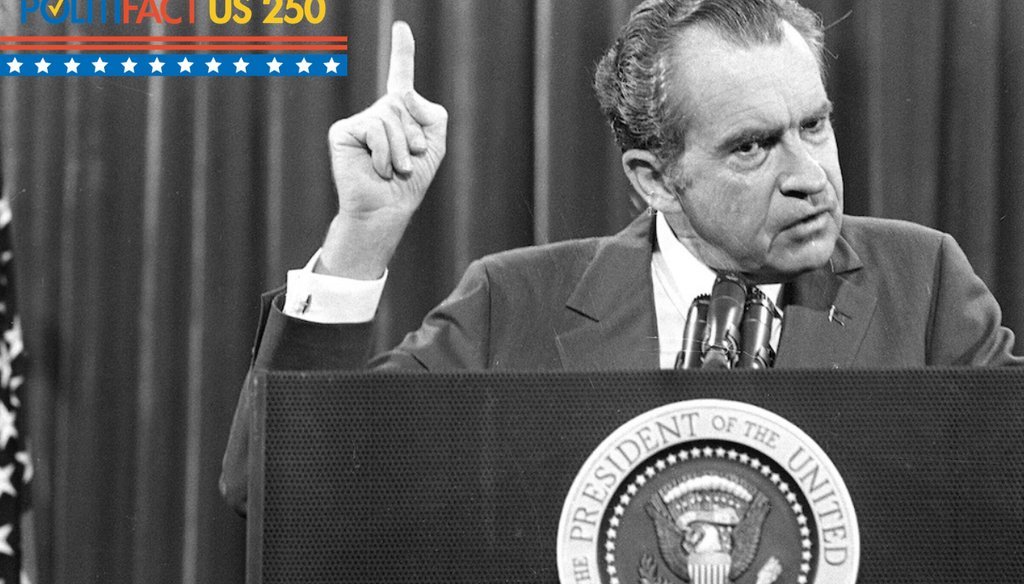
Nixon and Watergate
As the Watergate scandal unfolded, President Richard Nixon repeatedly denied White House involvement in the break-in and subsequent cover-up.
In August 1972, Nixon said no one currently employed by the administration had been involved in the affair. The statement proved false as investigators uncovered extensive participation by White House aides and administration officials.
The scandal ultimately forced Nixon's resignation in 1974.
Reagan and Iran-Contra
In 1986, President Ronald Reagan told Americans that the United States had not traded arms for hostages held in the Middle East.
Subsequent investigations showed that weapons had, in fact, been transferred to Iran while administration officials hoped to secure the release of American hostages. Reagan later acknowledged that the evidence contradicted his earlier statements.
The affair became one of the most significant scandals of his presidency.
Clinton and Lewinsky
Facing allegations of an affair with White House intern Monica Lewinsky, President Bill Clinton declared: "I did not have sexual relations with that woman, Miss Lewinsky."
The statement became untenable after evidence emerged of their relationship. Clinton later acknowledged an inappropriate relationship while arguing that his original denial reflected a narrow legal definition of sexual relations.
The controversy led to Clinton's impeachment by the House, though he was acquitted by the Senate.
Bush and Iraq's weapons of mass destruction
In the months before the 2003 invasion of Iraq, President George W. Bush repeatedly warned that Saddam Hussein possessed weapons of mass destruction and was rebuilding nuclear capabilities.
No stockpiles of such weapons were found after the invasion. Later reviews concluded that U.S. intelligence assessments were deeply flawed, though historians continue to debate the extent to which administration officials overstated the certainty of the evidence.
The episode remains one of the most consequential intelligence failures in modern U.S. history.
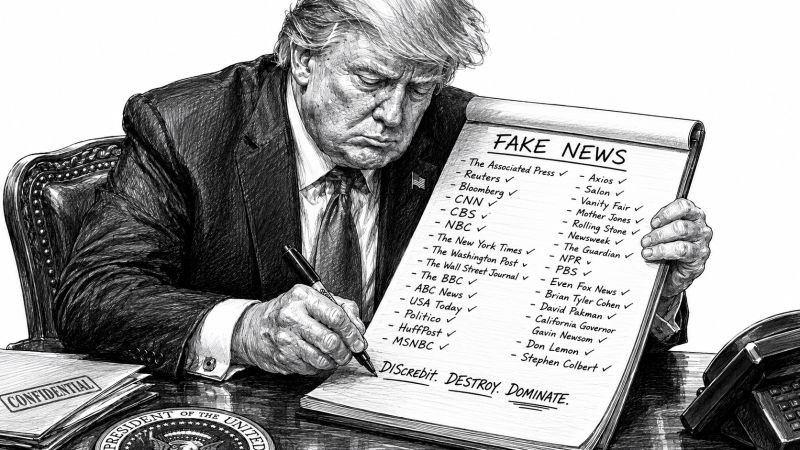
Trump and comments
After losing the 2020 election, President Donald Trump repeatedly claimed that widespread fraud had deprived him of victory.
Courts, election officials from both parties and multiple investigations found no evidence of fraud on a scale that would have changed the outcome. Nonetheless, the claims became a defining feature of American politics after 2020.
The allegations fueled efforts to overturn the election results and helped set the stage for the Jan. 6, 2021, attack on the U.S. Capitol.
NOTE: we have been asked to consider including are John Adams (Alien and Sedition Acts rhetoric), Woodrow Wilson (claims surrounding wartime dissent and democracy), Franklin D. Roosevelt (campaign promises about avoiding war before U.S. entry into WWII), and Barack Obama ("If you like your health care plan, you can keep it" during the Affordable Care Act debate), though some examples are disputed and would require careful framing to maintain consistency with the list.
Respond with additional feedback: DONews - doseoofnews at gmail . com