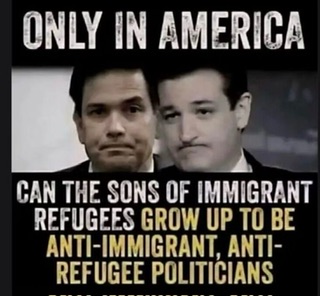
Marco Rubio and Ted Cruz love to tell the story of their Cuban roots. It’s part of their political brand, the sons of Cuban immigrants who embody freedom, faith, and the American Dream.
However, the version of Cubans they invoke isn’t the one I recognize. It’s not the Cuba of laughter and music, of resilience and family, of people who create joy in the face of hardship. It’s a Cuba stripped of its humanity and turned into a GOP talking point.
Rubio is the third child of Mario Rubio Reina and Oriales Rubio, who immigrated to the United States in 1956, during the Batista regime, before Fidel Castro’s revolution. Cruz was born a year earlier, in 1970, in Canada to Eleanor Elizabeth Wilson and Rafael Cruz, who also left Cuba before Castro came to power. Both men’s families sought opportunity, not necessarily asylum.
And yet, both politicians have built careers on the mythology of exile, invoking their parents’ journey as proof of the dangers of socialism and the virtue of conservatism. Rubio once falsely claimed his parents fled Castro’s regime; Cruz rarely misses a chance to remind audiences of his father’s suffering under communism. Their Cuba is frozen in the 1950s, an eternal cautionary tale that conveniently aligns with Republican Party messaging.
But Cuba is more than a political symbol. It’s a living culture, one that refuses to be defined by ideology alone. As a Cuban who immigrated to the United States after Castro, was educated here, and had the honor of being recruited by President George H.W. Bush’s administration, I know both countries intimately. I’ve seen how easily politicians turn identity into performance, and how far that performance can drift from authenticity.
Rubio and Cruz’s version of “Cuban” politics celebrates toughness but forgets tenderness. It honors struggle but ignores solidarity. They speak often about freedom, yet they support policies that deny it to others, from migrants seeking asylum to women seeking autonomy. Their rhetoric on “the border” and “American values” may win applause, but it betrays the deeper compassion that defines our community.
The real Cuban spirit isn’t found in speeches about socialism. It lives in small acts of perseverance, in neighbors sharing food, in families sending money home, in laughter that refuses to die even when times are cruel. It’s a culture that survived empire, dictatorship, and exile not through ideology, but through humanity.
Rubio and Cruz have traded that humanity for power. They’ve turned their heritage into armor, using it to deflect criticism while embracing the very policies that wound immigrant families like their own once were. In doing so, they have become symbols not of the Cuban experience, but of its distortion, politicians fluent in nostalgia but strangers to empathy.
My birthplace is warm, generous, and alive. It does not harden the heart or weaponize pain. It builds, it heals, it endures. And it deserves to be represented by something more than slogans and sound bites.
Rubio and Cruz may carry Cuban names. But the Cuban spirit, that indomitable mix of hope, humor, and heart, lives elsewhere. It lives in the people who remember where they came from without forgetting what it means to be human.
Remember, Marco Antonio Rubio’s parents were Cubans who immigrated to the United States in 1956, during the Batista regime, two and a half years before Fidel Castro came to power. Rafael Edward “Ted” Cruz was born in 1970 in Calgary, Alberta, Canada. His father, too, was Cuban, born and raised on the island before leaving for the United States.
Both men often invoke their Cuban roots when speaking about freedom, faith, and the dangers of socialism. Yet, as a Cuban who moved to the U.S following the Communist revolution, I studied here, and was later recruited by POTUS Bush’s administration, I can’t help but feel that these two figures do not truly represent the Cuban spirit.
The Cuban story is not just one of escape from communism or loyalty to a political ideology. It’s the story of people who built lives out of scarcity, who turned loss into laughter, who blended rhythm and resilience. The Cuban spirit is generous, joyful, and proud. It’s about community as much as it’s about survival.
Rubio and Cruz have built political brands rooted in their family’s Cuban heritage, yet what they project feels more like Washington calculation than Habana corazón. Their rhetoric may honor the struggle against tyranny, but it rarely captures the warmth, humor, and humanity that define the everyday Cuban lifestyle.
The Cuban identity is not a prop. It’s a pulse. It lives in our music, our food, our storytelling, and our compassion for others. We came to this country to build, not to fight. We wanted freedom, yes, but also dignity, decency, and the right to dream.
Both men love to remind Americans of their Cuban roots. They talk about their families fleeing tyranny, about socialism as a threat to freedom, about the need to defend “American values.” But what they rarely talk about is the Cuba that existed before tyranny and beyond politics, the one filled with humor, compassion, music, and human warmth.
Rubio and Cruz have turned their heritage into Republican talking points, not a testimony. They use Cuba as a backdrop for conservative posturing, not as a living connection to a people who have endured both dictatorship and exile. Their version of the Cuban story appears stripped of empathy. It’s weaponized to justify harsh policies toward migrants, toward the poor, or anyone who doesn’t fit their ideology.
Rubio, who once claimed his parents fled Castro when in fact they left under Batista, has built a career on rewriting his own family history to fit a political narrative. Cruz, who rarely misses an opportunity to invoke his father’s suffering, seems far more comfortable quoting Ronald Reagan than José Martí. Both men speak of freedom as if it were a slogan, not a shared human condition.
The Cuban spirit is not about vengeance or ideological purity. It’s about survival, faith, laughter, and generosity. It’s about starting over with nothing and still finding a way to make music, cook for your neighbors, and dance when life is cruel.
Rubio and Cruz have lost their ritmo Cubano. Their Cuba is a stage prop. The real Cuban spirit, the one I know from experience, is not cold or calculating. It’s warm, alive, and human. And it belongs to the people who live it every day, not to the politicians who exploit it.