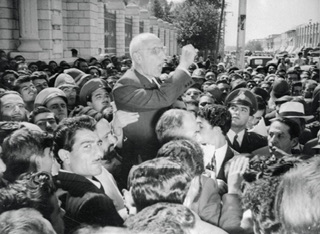
Iranian attitudes toward the U.S. government come from a mix of historical events, political narratives, and personal experiences, and they’re not uniform across all Iranians.
The 1953 coup (a foundational grievance)
The event you described—1953 Iranian coup d'état—is widely seen in Iran as a turning point.
- Mohammad Mossadegh was democratically elected and popular for nationalizing oil.
- The U.S. and U.K. backed his removal and strengthened Mohammad Reza Pahlavi.
- Many Iranians view this as the U.S. overthrowing their democracy for strategic and economic gain.
Even today, this event is taught and remembered as proof that foreign powers interfered in Iran’s sovereignty.
Support for the Shah (1953–1979)
After the coup, the U.S. strongly supported the Shah:
- His rule became increasingly authoritarian.
- His secret police (SAVAK) repressed dissent.
- The U.S. is often seen as backing this system.
So for many Iranians, resentment isn’t just about the coup—it’s about decades of perceived U.S. support for an unpopular regime.
The 1979 Revolution and hostage crisis
The Iranian Revolution overthrew the Shah and brought an Islamic government to power.
Shortly after:
- Iranian students seized the U.S. embassy.
- The Iran hostage crisis lasted 444 days.
From the Iranian revolutionary perspective, this was partly about preventing another U.S.-backed coup. From the American perspective, it was a major violation of international law—so distrust deepened on both sides.
Ongoing tensions and sanctions
Since 1979, relations have stayed hostile:
- Economic sanctions imposed by the U.S. have significantly affected ordinary Iranians.
- Military tensions and incidents (like the killing of Qasem Soleimani in 2020) reinforce negative views.
- Iranian leaders frequently use anti-U.S. rhetoric, which also shapes public opinion.
Important nuance: not all Iranians “hate” the U.S.
It’s really important not to overgeneralize:
- Many Iranians distinguish between the U.S. government and American people.
- American culture, education, and technology are often admired.
- Public opinion varies widely depending on age, politics, and personal experience.
Bottom line
The resentment you’re describing largely comes from a historical narrative like this:
- Foreign interference (1953 coup)
- Support for authoritarian rule (the Shah)
- Ongoing political and economic pressure (sanctions, conflicts)
But it’s not a simple or universal “hatred.” It’s a layered mix of history, politics, and lived experience, and some Iranians see it very differently.
https://www.pbs.org/newshour/world/in-first-cia-acknowledges-1953-coup-…