My grandpa and Godfather Oscar Bonachea y Valdés, served as Secretary of Commerce until 1940 under Cuba’s last democratically elected under President Laredo Brú’s administration. Fulgencio Batista succeeded him. He won the 1940 election and took office on October 10, 1940, the first president under the new 1940 Constitution, which Laredo Brú's term had produced through a freely elected constituent assembly. He governed with a broad coalition that included the Communist Party. Cuba sided with the Allies in World War II. This is when Batista became a wannabe dictator strongman and would not step down. It took Castro about a decade to take over, doe it sound familiar?
The ideology of power and Communism. The Cuban Revolution began as a coalition against Cuban dictator Fulgencio Batista before it became the political system of Fidel Castro.
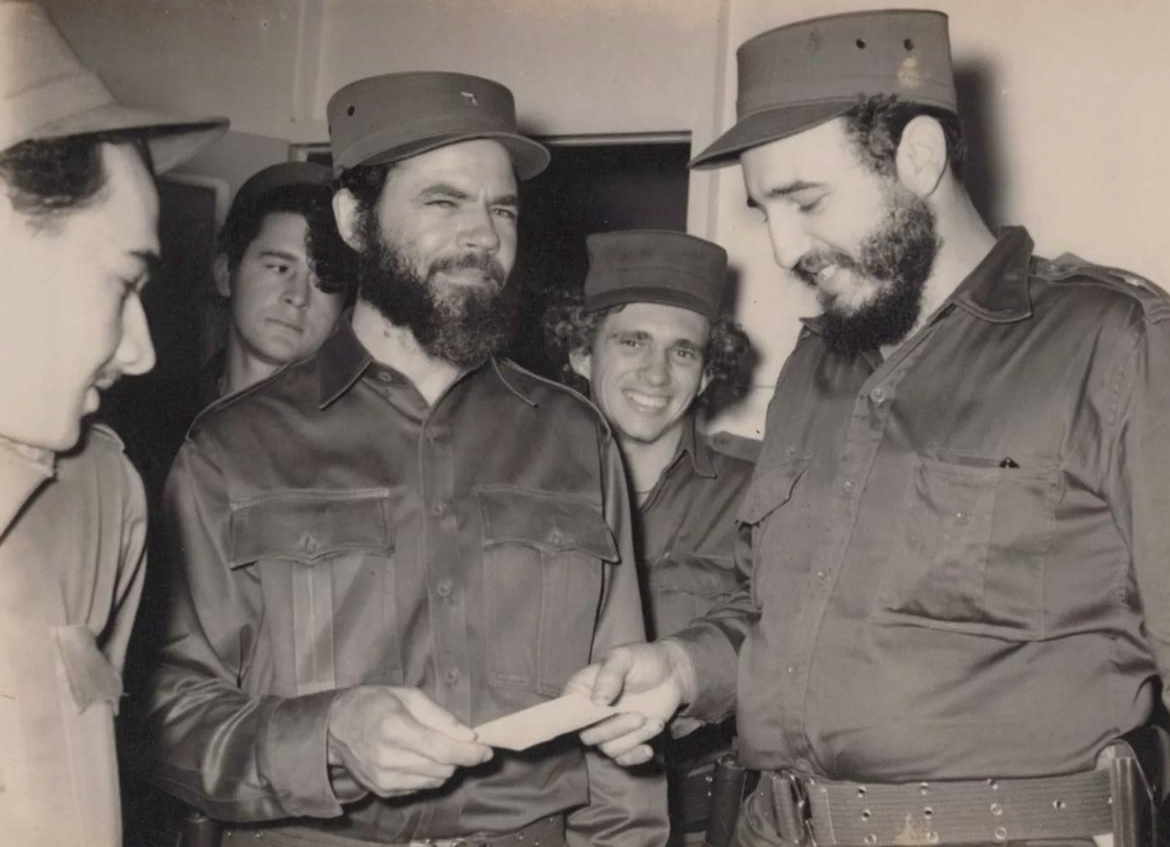
How did the Castro brothers meet Che, Camilo and Huber, then managed to form an organic Cuban revolution?
These men did not meet and decide to foment a revolution. What became the Cuban Revolution was assembled from several overlapping networks of students, political activists, exiles, guerrillas, urban underground organizers, and rural supporters. Fidel Castro was unusually effective at connecting those networks under his July 26 Movement, while allowing very different personalities to work toward the immediate common objective of removing Cuba's Dictator, Fulgencio Batista.
Castro Central Casting


Fidel and Raúl Castro were brothers from Oriente province who became political activists. Fidel's failed Moncada Barracks attack in July 1953 made him nationally known, imprisonment turned him into a political symbol, and exile in Mexico provided the opportunity to reorganize.
There, the crucial connection occurred.
Fidel meets Che in Mexico
After Fidel's release from prison in 1955, he went into exile in Mexico and began assembling the expedition that would eventually sail aboard the ship Granma.
Ernesto "Che" Guevara, an Argentine physician, had arrived in Mexico after traveling through Latin America and becoming increasingly committed to revolutionary politics. He met Raúl Castro first through Cuban revolutionary circles. Raúl introduced him to Fidel.
The meeting with Fidel was consequential: Guevara initially intended to serve as the expedition's doctor, but became one of Fidel's most committed guerrilla commanders.
So to be clear, Che wasn't recruited from Cuba into Fidel's original movement. He was an international revolutionary who joined the Cuban struggle in Mexico.
Camilo came through a different road
Camilo Cienfuegos was a Cuban working-class activist from Havana who had been involved in opposition to Batista. He eventually went into exile and, like Fidel, ended up in Mexico.
He joined Fidel's expedition and sailed on the Granma in November 1956.
That expedition was initially disastrous. The landing was late, difficult, and exposed the rebels to Batista's forces. Only a fraction of the original expeditionaries survived and reached the Sierra Maestra.
That is important because the revolution was not initially a large popular army. It was a small, battered nucleus that survived long enough to expand.
Raúl built another revolutionary center
Raúl was more than Fidel's younger brother. He became an important commander in his own right.
As the guerrilla movement expanded, Raúl established what became known as the Second Front in eastern Cuba. His organization attracted peasants, young people and other anti-Batista fighters.
U.S. diplomatic reporting in 1958 estimated Raúl's force at thousands of men, describing it as consisting of both peasants and urban youth. Office of the Historian
That illustrates something fundamental about the revolution:
There wasn't one Cuban revolutionary army at the beginning. There were several armed and clandestine movements that increasingly coordinated with one another.
And then there was Huber Matos
Huber Matos came from yet another part of the anti-Batista resistance. He was a teacher and political opponent of Batista who joined Fidel's forces in the Sierra Maestra and eventually became one of the movement's senior commanders.
He was given command of the July 26 forces in Camagüey Province. Office of the Historian
Matos is particularly important to understanding the word "organic."
He was not a communist revolutionary in the same political sense later associated with Raúl and Che. Like many people who joined Fidel, he saw the struggle principally as a fight against Batista and for political change.
That difference would become explosive after the revolution.
The secret sauce: Fidel's umbrella
Fidel's greatest organizational achievement was arguably not inventing every component of the revolution, but bringing disparate anti-Batista forces into a common political-military framework.
The July 26 Movement eventually absorbed or coordinated with:
- Sierra Maestra guerrillas
- urban underground networks
- student activists
- workers
- peasants
- middle-class professionals
- independent military commanders
- sections of other revolutionary organizations
There were also important movements outside Fidel's organization, particularly the Revolutionary Directorate.
The U.S. State Department reported in 1958 that the Revolutionary Directorate had its own armed force in the Escambray and that other youth and opposition organizations were simultaneously fighting Batista. Office of the Historian
The extraordinary part: they learned to cooperate
By 1958, Fidel had enough strength to begin sending his commanders westward.
He sent Che Guevara and Camilo Cienfuegos with separate columns across central Cuba toward Las Villas.
One contemporary U.S. diplomatic account estimated Guevara's column at about 150 men and Camilo's at roughly 120. Both made the extraordinarily difficult crossing, with Camilo's force demonstrating particular mobility in open country. Office of the Historian
That is where the seemingly disparate pieces began functioning as a revolutionary system:
Fidel → strategic leadership
Raúl → eastern front
Che → guerrilla commander/organizer
Camilo → mobile military commander
Matos → Camagüey commander
Urban underground → sabotage, intelligence, recruitment and political organization
Peasants → food, shelter, guides and recruits
Students and middle class → money, communications and political legitimacy
And beneath all of it was something even more important: Batista's government was progressively losing legitimacy and coercive effectiveness.
By the end, the rebels weren't simply defeating Batista militarily. They were exploiting the collapse of his political authority.
A U.S. Embassy assessment after Batista fled concluded that the July 26 Movement's rapid takeover was facilitated by broad popular support, the armed forces' decision to stop fighting, and the general strike. Office of the Historian
But here's the fascinating historical twist
The coalition was much more ideologically diverse than the Cuba that emerged afterward.
Matos, for example, eventually became an opponent of Castro and was imprisoned. Even within the U.S. government's early 1959 assessment, officials recognized substantial differences inside the revolutionary coalition: one grouping around Che and Raúl was described as more radical, while another around Fidel and allied elements was characterized as more oriented toward moderate reform at that particular moment. Office of the Historian
So the revolution's "organic" quality was real, but it wasn't because everyone shared the same ideology.
They shared an enemy first.
That is perhaps the most important lesson in understanding how the revolution formed:
The Cuban Revolution began as a coalition against Batista before it became the political system of Fidel Castro.
And that distinction explains a great deal of what happened between 1956 and 1961: the same coalition that successfully overthrew Batista eventually fractured over what the revolution itself was supposed to become.
If you'd like, I can take this one step further and reconstruct the actual human network from 1953 → Mexico 1955 → Granma 1956 → Sierra Maestra → Havana 1959, showing who introduced whom and how Fidel gradually became the central node. That story is almost like a political thriller.
The Cuban revolution was launched in July, during a hot Caribbean Summer and cemented in a January Winter.