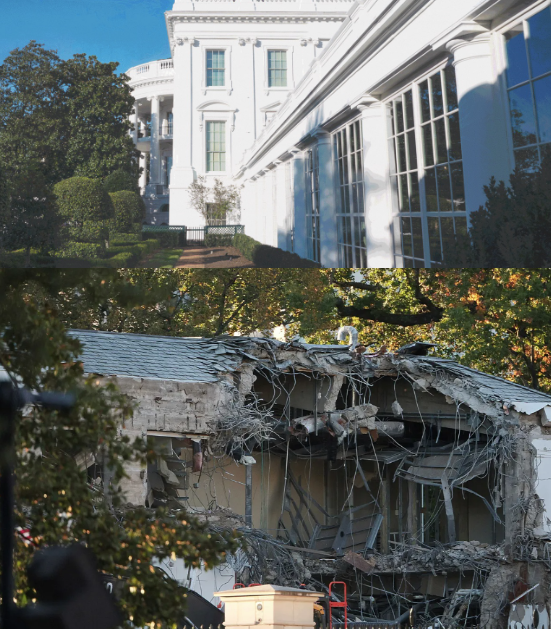
President Donald Trump’s new ballroom project, initially billed as a $100 million expansion, has ballooned to an estimated $250 million. The massive new structure is expected to dwarf the existing buildings. The East Wing, which has remained largely unchanged since 1942, currently measures about 12,000 square feet, while the main residence spans roughly 50,000 square feet.
Despite assurances from Trump in July that construction would not “interfere with the current building,” recent demolition work suggests otherwise.“It won’t be. It’ll be near it, but not touching it, and pays total respect to the existing building, which I’m the biggest fan of. It’s my favorite place,” Trump said at the time. Yet, Press Secretary Karoline Leavitt stated later that month that “necessary construction will take place” to “modernize” the East Wing.
What began as a $100 million dream project has doubled, and then some. Donald Trump’s latest addition, a sprawling ballroom complex, is now expected to cost around $250 million, transforming the White House’s familiar profile. The East Wing, unchanged since 1942, covers just 12,000 square feet; the main residence, 50,000. Trump’s new addition will eclipse them both. Even as demolition crews begin their work, Trump’s earlier pledge rings in the background: “It won’t interfere with the current building,” he said in July, calling it his “favorite place.”His press team struck a different note soon after. “The necessary construction will take place,” Press Secretary Karoline Leavitt confirmed, framing the expansion as part of a “modernization” effort.
The Architecture of Autocracy
Authoritarian leaders often begin with buildings. Hitler’s Reich Chancellery was redesigned to intimidate; its vast halls, towering ceilings, and ceremonial spaces were meant to dwarf the individual and elevate the regime. The ballroom was part of this transformation: a place where spectacle replaced substance, and where the state became a stage.
Donald Trump’s approach to space and symbolism follows a similar pattern. From gold-plated interiors to militarized parades, from staged photo ops in front of churches to the redesign of civic spaces for personal branding, the message is clear: governance is theater, and the leader is the star.
Architecture, in this context, is propaganda made permanent. The dictator’s palace, the “people’s house” renamed or remodeled, the monument to self—all serve one purpose: to recast public institutions as personal possessions. When Trump boasts of expanding or rebuilding, it’s rarely about utility. It’s about scale, spectacle, and subjugation. The walls grow higher not to protect the people, but to enshrine the ruler.
What we are witnessing isn’t just the politics of ego, it’s the aesthetics of autocracy. And like all regimes that mistake grandeur for greatness, the true cost will not be measured in square footage, but in freedom.

