When we asked Americans what makes them proud of the U.S., freedom was the most common answer.
Fascism: "A strong nation restored through unity, strength, and decisive leadership."
Communism: "An economically just society achieved through revolutionary state power and collective ownership."
Democracy: "Freedom and self-government through equal political participation, protected rights, and accountable institutions."
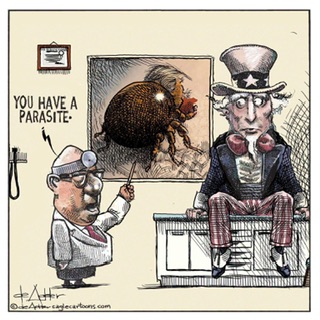
Uncle Sam, sick of lies paid a visit to the doctor, and was reportedly diagnosed with a serious political parasite.
Raskin Challenges Trump's Anti-Communism Push, Citing Past Praise for Authoritarian Leaders
President Trump and Republicans have launched a new campaign warning that communism poses a mortal threat to American democracy and the Constitution. But so does Fascism.
Congressman Jamie Raskin, Democrat of Maryland, is pushing back. Raskin points to years of documented comments in which Trump praised authoritarian leaders... including his description of a close relationship with North Korean leader Kim Jong Un and the letters the two exchanged, his call of Chinese President Xi Jinping "brilliant," and his characterization of Russian President Vladimir Putin's invasion of Ukraine as "genius."
Raskin argues the shift... from earlier, unsubstantiated claims about immigrants eating pets, to warnings about communism and fascism... may signal a new messaging strategy for the months ahead.
Two Ideologies, One Common Thread
Fascism and communism differ sharply in their goals, but both concentrate power in a single leader.
Fascism promises national rebirth through militarism, ethnic nationalism, and discipline... under a dictator.
Communism promises economic justice through revolutionary transformation and centralized planning... also under a dictator.
Democracy Promises a work in progress and a proccess
Unlike those ideologies, American democracy is not organized around a single promised end state. It commits instead to:
Political equality... every citizen gets an equal vote and a voice in government.
Individual rights and liberties... protected even when unpopular.
Peaceful transfer of power... governments change through elections, not coups.
Accountability... leaders can be criticized, investigated, and voted out.
Pluralism... competing viewpoints coexist without requiring ideological uniformity.
Self-government... citizens collectively chart their own direction.
Democracy does not promise national greatness, economic equality, moral unity, or a final social order. As one civics formulation puts it: "You may not always get the policies you want, but you have a voice in choosing your government, your rights are protected, and you can work to change its direction peacefully."
That dispersal of power can make democratic government slow and messy. Supporters call that a feature, not a flaw... designed to manage disagreement without dictatorship or political violence.
https://www.mariashriversundaypaper.com/were-divided-but-theres-more-to…