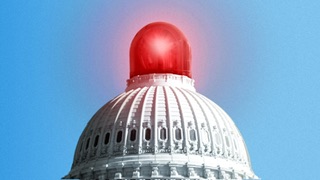
In 1961, a young FCC Chairman named Newton Minow stepped before the National Association of Broadcasters and delivered what would become the most famous indictment of American television ever uttered from a government podium. The airwaves, he declared, were a "vast wasteland" — a sprawling gray zone of violence, numbing commercials, and stupefying boredom. The room was not amused. Minow, a Democrat appointed by President Kennedy, didn't care.
More than six decades later, the wasteland metaphor has taken on a different and darker meaning. The landscape Minow surveyed — a handful of broadcast channels, limited spectrum, captive audiences — is almost unrecognizable today. And yet the instinct to control it? That has never wavered.
The Regulator's Eternal Temptation
Today's FCC Chairman, Brendan Carr — a Republican and Trump appointee — has floated the idea that the FCC could challenge broadcast licenses over news content he deems "fake news." He is the proud author of the FCC chapter in Project 2025, a blueprint for restructuring the federal government that envisions a far more muscular, politically directed regulatory apparatus.
Let us be plain about what this represents: the use of licensing power as a political weapon. The FCC's authority to grant and revoke broadcast licenses was always premised on the scarcity of the electromagnetic spectrum. The government owns the airwaves; broadcasters are guests. That's the constitutional bargain that has survived First Amendment scrutiny since Red Lion Broadcasting Co. v. FCC in 1969.
But the logic of that bargain was always fragile. Scarcity justified regulation. Abundance — the kind that the internet has delivered in staggering, almost incomprehensible quantities — blows that logic to pieces.
VHF to UHF to URL: The Regulator's Rout
Here is the technological irony that Washington has never fully digested: the very revolution that gave us Netflix, YouTube, podcasts, and streaming in a thousand flavors has also made the FCC's most dramatic ambitions largely moot.
Television once traveled over VHF frequencies — channels 2 through 13, the ones your parents turned with a dial. Then came UHF, expanding the spectrum with channels reaching into the seventies and beyond. Each expansion was still legible to regulators. The signal came from a tower. The tower had a license. The license had conditions.
Then came the URL.
When a show streams over the internet, it doesn't travel through licensed spectrum. It travels through packets — the same infrastructure that carries your email, your bank statements, and your grandmother's birthday photos. The FCC has no more authority over a Netflix original than it does over a letter mailed from Paris. The content is simply beyond its jurisdictional reach.
The great paradox: the more aggressively the FCC threatens legacy broadcasters, the faster audiences flee to platforms it cannot touch.
The Perverse Logic of Regulatory Overreach
This creates a profound and almost comic paradox at the heart of Carr's ambitions. If the FCC were to follow through on threats to revoke or challenge broadcast licenses over news content, it would not silence the press. It would accelerate the migration of audiences — and journalists — to the very platforms that regulators cannot control.
ABC News could lose its broadcast license and simply stream. CNN is already primarily a streaming product. The New York Times doesn't need a frequency assignment. Podcasters, YouTube channels, Substack writers, and independent journalists operate in a regulatory vacuum that the FCC is structurally unable to fill without a wholesale reimagining of internet law that Congress has shown no appetite to undertake.
In short, the regulators don't realize the boob tube has already escaped them. The transmitter is wherever you are. The channel is whatever you choose. The signal has gone everywhere and nowhere, and no license can recall it.
What Minow Understood That Carr Does Not
Newton Minow's "vast wasteland" speech was, at its core, a challenge — not a threat. He was goading broadcasters to do better, to honor the public trust embedded in their licenses, to use the privilege of spectrum access for something worthy of it. His critique was aesthetic and civic, not political.
Carr's posture inverts this entirely. Where Minow challenged broadcasters to serve the public, Carr threatens them for serving a public whose news judgments he dislikes. The distinction is not merely philosophical. It is constitutional. And it is the difference between a regulator who understood his role and one who has confused a public trust with a personal prerogative.
A Warning to Both Sides
None of this is to say the internet is a paradise of democratic discourse. It is not. Algorithmic manipulation, disinformation at an industrial scale, and the collapse of local journalism are genuine crises that no one has adequately solved. The vast wasteland has not disappeared — it has multiplied into ten thousand micro-wastelands, each optimized to confirm your existing beliefs and maximize your outrage.
But the answer to that crisis is not to give politically appointed regulators the power to decide which news is real. That path leads somewhere Minow — who lived long enough to see a great deal of history — would have recognized immediately. It leads somewhere that the framers of the First Amendment spent considerable effort trying to prevent.
The signal has moved. The audience has moved. The threat, unfortunately, has moved with them — wearing a different uniform, carrying different tools, but pursuing the same ancient ambition: to decide what the people are allowed to hear.
#CityImages welcomes responses and rebuttals. CityImages3@gmail.con
Minow's 1961 challenge — framed as a civic dare, not a political threat
Carr's inversion of that legacy — licensing power as a political weapon
The technological knockout punch — VHF → UHF → URL, and FCC's jurisdiction evaporated along the way
The great paradox — heavy-handed FCC pressure accelerates the exodus to platforms it can't touch
A warning to both sides — acknowledging that the internet is its own kind of wasteland, while firmly rejecting state-controlled media as the cure.

