Following the Spanish-American War, the U.S. military directly administered the island until 1902, when Cuba became a republic, with sugar as its main commercial export. After a financial crisis and persistent governmental corruption, Gerardo Machado was elected as Cuba’s president in 1925, pledging reform. Instead, Machado became Cuba’s first dictatorial ruler, until he was ousted in 1933 after a revolt led by Fulgencio Batista, a rising star in the Cuban military.
Various presidents came and went over the next two decades, but Batista remained a constant force. He served as president himself from 1940-44, and ran for a second term in 1952. Facing defeat, he overthrew the government in a bloodless coup and canceled the elections.
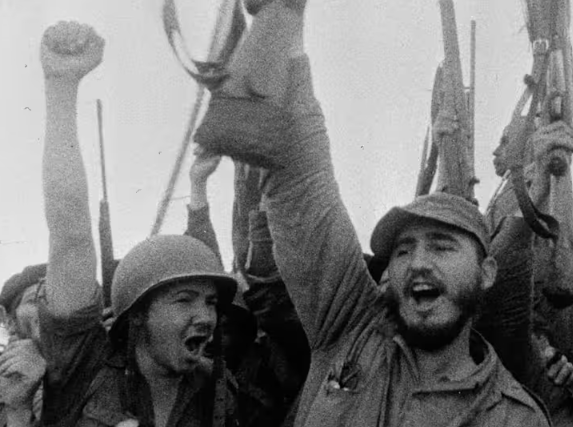
Castro, a young lawyer and activist, had been running for Congress as part of the Cuban People’s Party before Batista seized power. Seeking to arm a revolutionary opposition to the Batista regime, he led a raid against the Moncada army barracks in the city of Santiago de Cuba on July 26, 1953. Most of the group was killed; Castro and his younger brother, Raúl, escaped but were later arrested and imprisoned.
Fidel Castro’s trial and imprisonment served to build his reputation as a revolutionary leader. After Batista yielded to international pressure and granted amnesty to many political prisoners in 1955, Castro headed to Mexico, where he began organizing Cuban exiles into a movement named for the date of the failed Moncada attack.
In November 1956, 82 men representing the 26th of July Movement sailed from Mexico aboard the Granma, a small yacht. Batista’s forces learned of the attack ahead of time, and ambushed the revolutionaries shortly after they landed in a remote area of eastern Cuba on December 2, 1956. Though most of the group was killed, around 20 of them escaped, including Fidel and Raúl Castro and one of Castro’s foreign recruits, Argentine-born doctor Ernesto “Che” Guevara.'
Beyond the blackouts, the run-up to this year's anniversary has been unusually tense. In February, a firefight broke out between Cuba's Border Guard and a U.S.-registered speedboat off Villa Clara province, Cuban authorities said the boat's occupants opened fire first, and five people were killed in the exchange, part of a broader pattern of friction Havana has tied to what it calls U.S.-backed infiltration attempts. That came weeks after the U.S. moved militarily against Venezuela and took custody of then-president Nicolás Maduro, a strike that also cut off Cuba's main lifeline of subsidized oil and deepened the fuel shortages driving the blackouts.
Despite the hostility, Díaz-Canel has publicly acknowledged direct talks with Washington aimed at addressing the energy blockade, and Cuba has released more than 2,000 prisoners this year as part of that opening, though the fuel and power crisis has only worsened since, with the energy ministry confirming in May that the country had run out of oil and diesel entirely. Trump, for his part, has invoked the Monroe Doctrine directly regarding Cuba, and members of his administration have openly floated the idea of new leadership on the island.
So the Moncada anniversary this week isn't just ceremonial nostalgia, it's landing in the middle of live negotiations, a shooting incident with U.S. citizens killed, and the worst blackouts of the post-Soviet era, with real questions in Washington and Havana about whether the 67-year Castro-line government survives this round intact.
Universal Newsreels on Cuba, 1959-1961
https://www.c-span.org/program/american-history-tv/universal-newsreels-on-cuba-1959-1961/592084
IMAGE: Raul & Fidel Castro