I was recruited to lead Univision News by Joaquin Blaya and Jaime Davila, the UNIVISA Toppers.
SICC and SIN (1961–1976)
It started in San Antonio in 1961, when Rene Anselmo bought KWEX-TV and founded the Spanish International Communications Corp. Anselmo had worked in Mexico for Emilio Azcárraga Milmo, president of Telesistema Mexico, later Grupo Televisa — which indirectly financed SICC at the legal 20% foreign-ownership limit and supplied all its programming. SIN itself was set up to handle ad sales for the stations, then grew into a full network with more than 350 affiliates — essentially a Televisa-programmed pipeline into the U.S., dressed as a domestic broadcaster to satisfy FCC ownership rules. FundingUniverseFundingUniverse
Going national via satellite (1976–1981)
In 1976, SIN became the first commercial network to regularly distribute programming by satellite, turning a cluster of regional stations into a genuine national network that could reach smaller markets and rural areas, not just the big cities. Britannica
The birth of Spanish-language network news (1981)
On June 1, 1981, KMEX debuted Noticiero Nacional SIN, a half-hour weeknight newscast anchored by Guillermo Restrepo, later joined by Teresa Abate (later Teresa Rodriguez), who became the first Hispanic woman to anchor a national U.S. newscast. That broadcast is the direct ancestor of today's Noticiero Univision. Wikipedia
The FCC forces a sale (1986–1987)
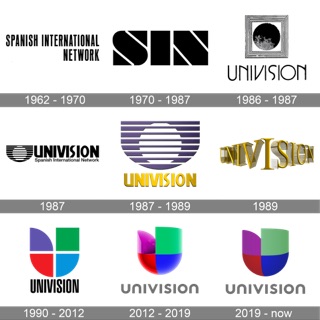
This is the pivotal moment. Foreign-ownership tensions boiled over after Azcárraga's death, leadership disputes erupted among Milmo, Anselmo, and other shareholders, and an FCC probe found foreign influence over the company exceeded legal limits, forcing the owners to sell. Hallmark Cards led a roughly $600 million buyout, and renamed the network Univision, though Hallmark then lost Televisa's telenovelas, which had been its most popular programming, when Televisa pulled out. SIN, essentially a Mexican-programmed operation wearing a U.S. broadcaster's face, became something legally and structurally American for the first time. BritannicaBritannica
Univision News takes shape (1987–1988 onward)
The renamed news division kept building out. Since 1988, the flagship evening newscast has been anchored by Jorge Ramos and María Elena Salinas, the pairing that defined Univision News for a generation and turned it into the most watched Spanish-language network newscast in the U.S., regularly outperforming Telemundo's newscast, with strong ratings even against English-language competitors. WikipediaWikipedia
Ownership churn continues
Univision itself kept changing hands — investor groups, private equity, and eventually a 2022 merger with Televisa's media assets to form TelevisaUnivision, now based in Doral, Florida, bringing the Mexican programming relationship full circle, decades after the FCC forced it apart. Britannica
The through-line that probably resonates most with your own career: SIN/Univision News spent its first 25 years proving that Spanish-language journalism in the U.S. could draw a mass audience and real advertising dollars, the "success" case, while the harder, slower-built thing was the credibility piece: getting Noticiero Univision treated as a legitimate national newscast rather than an ethnic sideshow. That's closer to the "value" side of your original framework, and it's the part that took Ramos, Salinas, and a generation of Univision reporters to actually earn.