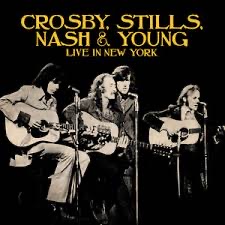
I Remember When CSNY Said Farewell on stage, but the Fillmore East Crowd Wouldn’t Buy It.
As a young concertgoer, I recall attending a Crosby, Stills, Nash & Young performance at New York’s Fillmore East when the group announced from the stage that it was saying farewell.
The announcement seemed serious enough. The audience’s response was immediate and unmistakable: boos, shouted objections, calls for the band to reconsider and a liberal sprinkling of an expletive. The crowd plainly wasn’t ready to accept the end of the group.
It remains one of my vivid memories of a remarkable concert and an era in popular music.
Formed in 1968, Crosby, Stills & Nash brought together three distinctive voices from the folk-rock scene. David Crosby, Stephen Stills and Graham Nash developed a sound built on intricate vocal harmonies, acoustic guitar interplay and thoughtful songwriting. Neil Young joined the group for its second album, Déjà Vu, released in 1970, adding a more unpredictable edge to an already distinctive musical partnership.
The album reached No. 1 on the Billboard 200 and produced enduring songs, including “Teach Your Children,” “Our House” and “Woodstock.” The group also recorded “Ohio,” Young’s urgent response to the 1970 killings of four students by Ohio National Guard members at Kent State University.
CSNY helped define the sound of a generation, combining personal introspection with social commentary at a time when American music was reflecting profound cultural and political divisions. Their harmonies were immediately recognizable, while the individual members’ strong personalities and musical independence made the group both compelling and notoriously difficult to keep together.
The band’s subsequent history included separations, reunions and further tours. Its 1974 reunion tour became a major event in rock music, but the tensions that marked the group’s relationships never entirely disappeared.
My memory of that Fillmore East announcement remains a small but telling illustration of the bond between performers and audience. Whatever the band intended by its farewell, the people in the room were not prepared to let the music end.
Apparently, the crowd had its own ideas about when CSNY should say goodbye… And so it goes.