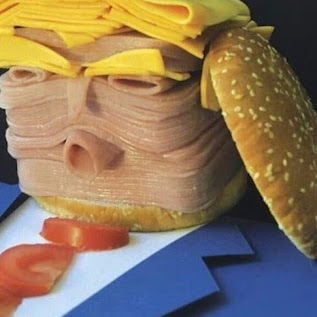
China's Xi and Russia's Putin are going to slice up all the baloney for and have it all for lunch. Xi and Putin sharing a Trump baloney sandwich.
But based on what's actually happening, probably not. The real reason is that Chinese believe timing is everything.
Xi is playing a longer, colder game. He just got Trump to come to him in Beijing, on Chinese terms. That's already a win. Xi doesn't need Putin to outmaneuver Trump; he's doing it with trade leverage, rare earths, and patience. Putin at this point is more of a liability to Xi than a partner. China doesn't want to be too closely associated with a losing war in Ukraine while trying to stabilize relations with the U.S.
Putin is the weakest of the three right now, which is almost the opposite of the "three equals dividing the world" scenario. He's showing up in Beijing essentially hat in hand, the day after Trump left. Xi will be cordial — he needs Russian energy and the partnership optics but he's not going to blow up his U.S. détente for Putin's benefit.
Trump, for all the baloney, is not without leverage either. The U.S. economy, dollar, and military umbrella still matter enormously to everyone in the room, including China. Xi is the one holding the knife, Trump brought the bread, Putin brought some baloney and borscht nobody really ordered, and they're all pretending it's a friendly picnic. Meanwhile in Habana, Cubanos are watching three amigos and and waiting.
The timing is delicious and could not be better, if Hollywood scripted this to produce a major motion picture.
So Putin lands in Beijing on May 19-20, and the date he's there to "celebrate friendship" happens to be Cuban Independence Day. The universe has a sense of humor.
For context, May 20 marks the day in 1902 when Cuba became an independent republic after the Spanish-American War though "independence" was immediately complicated by the Platt Amendment, which gave the U.S. the right to intervene in Cuban affairs and, of course, the Guantánamo lease. So Cuban independence was born already tangled up in great-power politics. Fitting metaphor, really.
The Cuba-Russia connection runs deep too the Missile Crisis of 1962 was essentially the last time the world came this close to the kind of great-power brinkmanship we're seeing echoes of now. And Cuba survived being a pawn on that chessboard, which is exactly your point they don't get moved easily.
There's almost a poetic irony in Putin celebrating "friendship and cooperation" with Xi on the same day that commemorates a small island nation's stubborn insistence on existing on its own terms, despite being squeezed between superpowers for over a century.
Cubans appreciate the symbolism and will certainly get plenty of miles making many jokes about it.
Three leaders may not yet be plotting to divide the world, but it is a geopolitical anxiety. It echoes historical moments like Yalta 1945, where major powers genuinely did carve up spheres of influence. Cynicism about great-power meetings isn't unfounded historically.
Cubans and Ukrainians have shown a stubborn, almost defiant national identity in the face of much larger powers trying to absorb or dominate them. Cuba has resisted U.S. pressure for over six decades despite being neighbors; Ukraine has been fighting for its sovereignty against another neighbor with vastly more resources. Both cultures have a strong streak of we will not be moved embedded in their national character. You can't keep good hardworking people down.
Ukrainians with a mustache is saying a lot because there's a certain machismo to the Cuban cultural image that does rhyme with the Cossack energy of Ukrainian identity.
Russia and China have used Cuba as a listening post effectively and may not play nice as Cubans persevere.
TRUTHS?
Trump just wrapped up a visit to China, and Putin is arriving in Beijing tomorrow, May 19–20. So Beijing is essentially hosting the world's three most powerful leaders back-to-back within days. Al Jazeera
Putin was watching the Trump-Xi summit nervously. His April 29 phone call with Trump was reportedly disappointing. His offer to store Iran's enriched uranium in Russia was rebuffed, with Trump telling him to focus on ending the war in Ukraine. The Conversation
The last face-to-face between Xi and Putin was September 2025, with only one video call since. Some analysts read the Kremlin's announcement of Putin's upcoming Beijing visit as smacking more of desperation than confidence. The Conversation
Xi sees Trump as transactional rather than ideologically driven, and calculates that economic inducements plus coercive leverage is the best way to manage him. Meanwhile Putin needs China economically but may be getting marginalized. European Union Institute for Security Studies
A Cubano can be a badass With China reportedly supplying 90 percent of Russia's dual-use technology as of May 2026, Ukraine doesn't view China as a neutral party and yet Ukraine is still in the fight. The mustache-Cossack energy endures. The Diplomat
The world isn't being divided yet but everyone is jockeying for position, with Beijing holding the best cards, and not Washington.