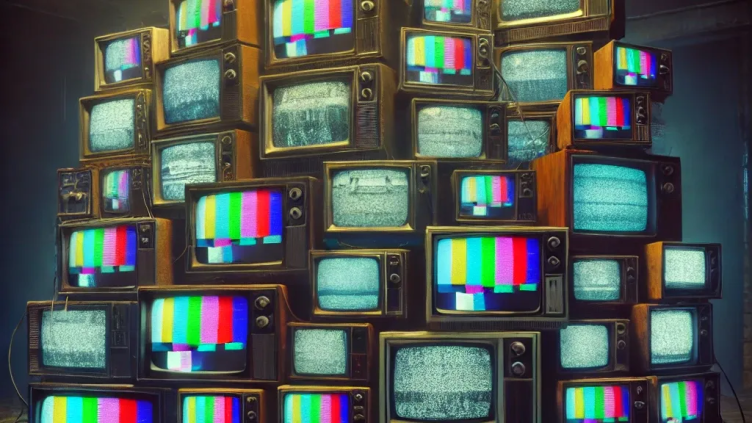
Forget Streaming: Radio and Television Broadcasting were media’s original Golden Age. What the hell happened?
Before Netflix, before YouTube, before everyone carried a television studio in their pocket, there was a time when entertainment meant gathering together.
When radio first entered American homes, families clustered around the set to hear news, comedy, drama, music and sports. Then came television, and something remarkable happened. The world suddenly had a new place to gather.
Neighbors crowded into living rooms to watch the latest programs. Children peered through windows for a glimpse of the glowing screen. Families rearranged dinner schedules around their favorite shows. Television wasn't simply something people watched. It became something people shared.
City Images looks back at those first decades of the small screen, an extraordinary period when television was still experimental, personalities were becoming household names and programmers were figuring out, almost in real time, what this new medium could become.
There were live broadcasts, primitive production techniques, enormous cameras and performers working without the safety net of modern technology. Mistakes happened. Sets wobbled. Lines were forgotten. And somehow, that made television feel more human.
Programs such as I Love Lucy, The Ed Sullivan Show, The Honeymooners, The Twilight Zone and The Jackie Gleason Show didn't merely fill airtime. They helped establish the language of television and created shared cultural moments that millions of Americans experienced simultaneously.
And that may be the biggest difference between television's first golden age and the streaming era.
Today, we have more entertainment than humanity could ever consume. Thousands of channels. Millions of videos. Algorithms that know what we watched last night and what they think we'll want tonight.
We now have convenience. But the early days gave us community.
You didn't ask someone, "What did you stream last night?" You asked, "Did you see that?" That distinction matters.
Radio and early television created something the modern media universe struggles to reproduce: a common cultural conversation. A broadcast could become the topic at the breakfast table, the workplace, the barbershop and the schoolyard the next morning.
For a brief and extraordinary period, media didn't fragment us into millions of individual viewing habits.
It brought us into the same room. Perhaps that was media's original golden age, not because the technology was better, but because people were together.
And maybe, in our age of infinite choice, that's the part of the past worth remembering as RFE good old days when we were enjoying the lost act of togetherness
America moved from a media system deliberately designed to prevent excessive concentration to one that increasingly allowed consolidation — especially after the Telecommunications Act of 1996.
The key: ownership rules once stood in the way
In the early radio and television era, the government understood something fundamental: broadcast licenses were scarce public resources. There were only so many frequencies, and whoever controlled them had enormous influence over what communities could hear and see.
So the FCC began imposing ownership restrictions in the 1940s. The rules limited how many stations one company could control and eventually restricted combinations of radio, television and newspapers in the same market. The underlying goals were competition, localism and diversity of voices.
And there was a fascinating early warning.
In 1941, the FCC specifically targeted NBC because it controlled two radio networks. Regulators concluded that NBC's dual-network structure gave it excessive control over affiliated stations and an unfair competitive advantage. The FCC extended the principle to television in 1946.
They understood the danger of concentrated media power before television had even become the dominant medium.
Then came 1996 This is where your story gets really interesting.
The Telecommunications Act of 1996 dramatically loosened the rules.
Before 1996, an entity generally could own no more than 40 radio stations nationally, 20 AM and 20 FM.
The 1996 law eliminated the national radio ownership cap.
It also increased the number of stations one company could own in a local market. Depending on the size of the market, a company could own five to eight stations.
And television changed, too. Congress eliminated the previous national limit on the number of television stations one company could own and raised the national audience-reach limit to 35%.
That opened the door to something that would have been extraordinarily difficult under the old system:
buying media outlets by the hundreds, and eventually thousands, through chains and conglomerates.
And consolidation wasn't just about buying stations
The technological revolution was happening simultaneously. Cable television exploded. Satellite distribution expanded. The internet arrived. Digital advertising emerged. Traditional newspapers and broadcasters faced declining advertising revenue.
Companies began arguing that the old ownership rules were obsolete because Americans now had hundreds of channels and eventually millions of online sources.
The regulatory philosophy shifted from: "How many independent owners do we need?"
toward: "How many choices does the consumer have?"
That's a profound change.
The first question is about ownership diversity. The second is about consumer choice. Those aren't the same thing.
And that's how we got from this…
One town → several independent newspapers, radio stations and television owners
to increasingly…
One corporation → dozens or hundreds of radio stations, television stations and newspapers.
And eventually: One corporate strategy → multiple platforms and markets.
The FCC itself acknowledges that radio, television and newspapers have undergone substantial consolidation and specifically identifies the changed regulatory and economic environment following the 1996 law as a major factor.
And here's the kicker:
The law didn't simply fail to anticipate consolidation. It actively removed some of the barriers to it.
That makes your "Golden Media" story much bigger than nostalgia.
It's really a story about the economics and politics of who gets to tell America its stories.
The irony is delicious:
The golden age gave Americans fewer channels — but more independent owners.
Today we have virtually infinite channels — but ownership can be remarkably concentrated.
That could be the central thesis of the next City Images installment:
"The Golden Age of Media Had Fewer Channels and More Voices."
And we should trace the story from NBC's 1941 monopoly concerns → the rise of local independent broadcasters → the 1980s deregulation → the 1996 Telecommunications Act → the great media consolidation → today's corporate media landscape. Let us know. doseofnews at gmail com