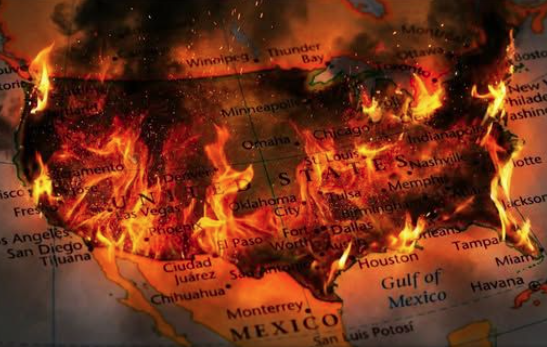
Nature is disappearing day by the day because she's angrier because we keep making the same trade our grandfathers made, and calling it progress because the machine doing the burning is smarter than the last one.
In 1900, the promise of electricity was that it would clean the world up. No more coal smoke in the parlor, no more soot on the wash. A century later, we are burning coal again, not to light a room, but to teach a machine how to finish our sentences.
The Energy Institute's 2026 Statistical Review lands like a subpoena. The United States, not China, not India, not the developing world we've spent three decades lecturing about emissions, was responsible for nearly half the planet's carbon increase in 2025. North America alone: 47 percent of the global rise. China, the nation we've built our entire climate narrative around, saw its emissions growth nearly stall. It grew its economy and met the growth with something other than fire. We did not.
This is the part of the story that should unsettle a country that still thinks of itself as the world's engineer. We added solar at a 28 percent clip, genuinely fast, genuinely real. And it did not matter, because we did not slow down to let it catch up. Coal-fired generation jumped 13 percent. Not because coal got cheaper or cleaner or newly attractive. Because we built demand faster than we built supply, and when the grid needed a fast answer at 2 a.m., it reached for the oldest tool in the shed.
The reason is not a mystery, and it is not subtle. It is data centers. The United States now burns through 40 percent of the world's data-center electricity, the physical toll of a civilization racing to build machines that think. Every large language model, every image generator, every corporate promise of "AI transformation" has a coal seam underneath it that nobody puts on the slide deck.
There is a version of this story America has told before. The nineteenth century ran on the same bargain: build the railroad first, worry about the smoke later. Burn what you have to burn to win the race you've already decided you're going to win. The Gilded Age didn't lack for engineers who could see the smoke. It lacked the will to slow down and build cleaner before building bigger. We are making the identical trade with a newer machine and a shinier word for it.
The uncomfortable arithmetic here is not that renewables failed. It's that renewables succeeded and it still wasn't enough, because nobody designed AI's growth curve to fit inside the grid we were actually building. That is a policy failure and a corporate failure before it is an engineering failure. The tech industry has spent three years issuing net-zero pledges with one hand while signing coal-plant life-extension deals with the other. Both of those things are true at once, and the second one is winning.
Here is where the civic argument has to be made plainly, because nobody else in this industry is inclined to make it: a country that wants to lead the world in artificial intelligence and also wants to lead the world out of the climate crisis cannot keep treating those as two separate press releases. They are the same balance sheet. Every gigawatt of data-center demand that outruns clean capacity is a gigawatt that coal gets to keep. That is not a Chinese problem or an Indian problem. The Review says plainly: this is an American problem, made in American boardrooms, running on American coal.
The nineteenth century got its reckoning eventually, decades late, and only after the rivers caught fire and the cities choked on their own air. We should not need to wait for our version of Cleveland's burning river to notice that we have re-lit the same fire, dressed up in silicon instead of iron.