This is one of the most contested issue in American politics, so to review lets walk through what's being said.
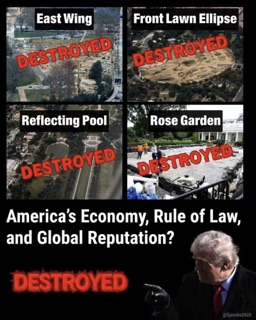
Economically, polling shows real public dissatisfaction: about three in ten Americans rate the economy as excellent or good, while roughly seven in ten call it only fair or poor, and Trump ended his first year back in office with a 36% approval rating, the lowest of any president at that point in the past five decades. A CNN poll cited by Axios found 70% of Americans disapprove of his handling of the economy, a number that never crossed 50% even during his first term. Researchers at CEPR have argued that tariff policy, pressure on the Federal Reserve, and the firing of the Bureau of Labor Statistics commissioner over data Trump disliked have damaged institutional credibility that's hard to rebuild quickly. On the international side, the same researchers argue the administration is accelerating fractures in the post-WWII rules-based order through unilateral tariffs that undermine core trade norms, and Axios's retrospective notes Trump turned decades-old alliances with NATO, Ukraine, Canada, and Denmark into the subject of public taunts. Domestically, critics point to expansive use of executive power — 225 executive orders in under a year, more than his entire first term, while Congress passed only 61 laws, plus Chief Justice Roberts's public statement in 2025 that the rule of law was "endangered" as evidence of strain on constitutional checks. Pew Research Center + 7
The US and Israel struck Iran on 2/28, killing its supreme leader and other officials, leading to a war that disrupted the Strait of Hormuz and ended, after months of on-and-off ceasefires, with a formal memorandum of understanding signed by the US and Iranian presidents on 6/17, intended to close the conflict within 60 days. The administration touts this as a foreign-policy win, Vance recently said oil flow through the Strait hit its highest level since the war began and called it proof the deal is holding.
But the alliance friction was real and is well documented. NATO and China both rejected Trump's request for military help reopening the Strait, and Trump called the decision a "very foolish mistake," later renouncing NATO's assistance and rebuking Japan, South Korea, and Australia for not joining the strikes. European diplomats told CNN that NATO allies were "totally surprised" by the US-Israeli strikes and had to evacuate citizens from the region without advance warning, even as Trump posted that NATO "wasn't there when we needed them, and they won't be there if we need them again". Defense Secretary Hegseth has since launched a review of US troop posture in Europe, with NATO allies' "shameful" response cited as a factor, and German Chancellor Merz publicly criticized the US for lacking a "truly convincing strategy," which reportedly contributed to a US troop drawdown from Germany. Spain went further, refusing to let the US use its air bases, which prompted Trump to threaten cutting trade with the country.
So the dispute again splits along the same lines as before: supporters see a president who took decisive military action, forced a ceasefire, and is now holding allies accountable for underinvesting in their own defense for decades. Critics see a president who alienated longtime allies by acting without consulting them, then publicly attacked the alliance itself when it didn't fall in line — with Lebanon's inclusion in the ceasefire still disputed and fighting continuing there even after the "deal."
The administration and allied outlets counter with a very different scorecard: negative net migration in 2025 for the first time in roughly 50 years, alongside what they describe as the largest homicide drop on record. DHS and House Republicans cite steep, sustained drops in border encounters, 91,603 nationwide encounters in the first quarter of FY2026, over 76 percent fewer than the same period a year earlier under Biden, as proof of a promise kept, not a harm done. On regulation, the White House claims the largest deregulation initiative in U.S. history, with roughly $5 trillion in projected savings. It's worth noting, though, that even sympathetic fact-checks caution these are largely administration-sourced figures whose long-term effects and independent verification remain disputed, and one academic study found border-crossing restrictions under both Biden and Trump had little immediate measurable effect, so even the "wins" column has real argument underneath it. White House + 4
Therefore, total "damage" isn't a settled fact so much as a framing, pretty much everyone agrees the second term has been unusually fast-moving and disruptive; people disagree sharply on whether that disruption nets out as harm (eroded alliances, institutional norms, affordability) or as overdue correction (reshoring, border control, and deregulation). Even the economic data itself is genuinely mixed, strong headline GDP growth in some quarters alongside historically low approval and consumer sentiment, which is part of why both "this is a disaster" and "the media won't credit real wins" narratives can each point to real numbers.