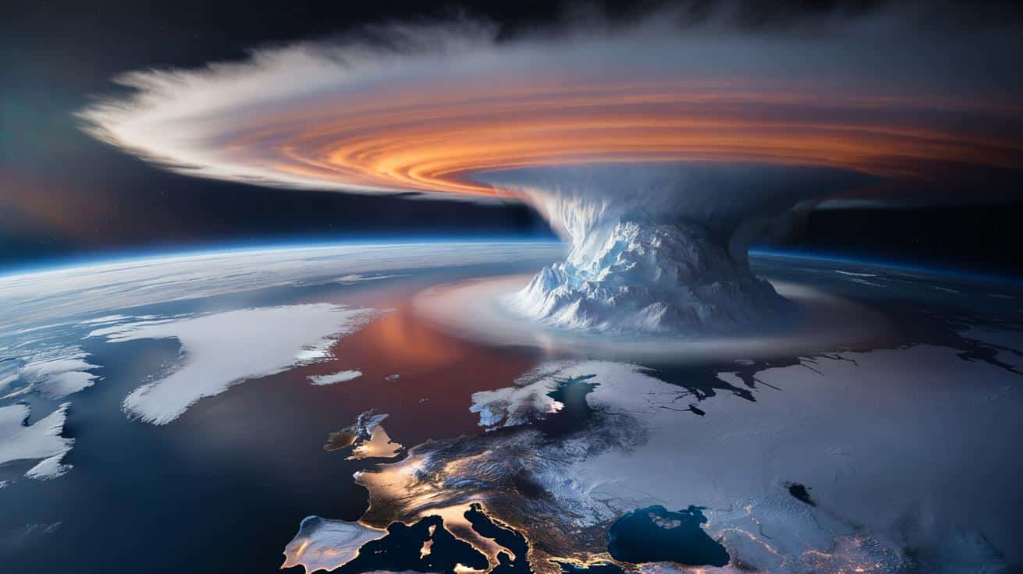
Scientists are warning of a Polar vortex faces disruption as rare late-season warming develops over Arctic
A vast whirl of icy air that typically corrals the Arctic’s deepest cold is showing signs of breaking down, as meteorologists track a rapid warming high above the North Pole.
The polar vortex, a powerful ring of west-to-east winds that circles the Arctic during winter, normally acts as a barrier, trapping frigid air in the far north. But satellite data and forecast models indicate that barrier may soon weaken.
Forecasters are detecting what is known as a sudden stratospheric warming, or SSW, a phenomenon marked by a sharp temperature spike in the stratosphere roughly 10 to 50 kilometers above the surface. In some areas over the pole, temperatures are projected to rise by 40 to 50 degrees Celsius within days.
Such events occur when atmospheric waves from lower levels of the atmosphere disrupt the polar vortex, slowing or even reversing the high-altitude winds that keep cold air locked in place. When that circulation weakens, the vortex can shift off the pole or split into multiple lobes.
Sudden stratospheric warmings are not unprecedented, but an event of this magnitude in February would be considered unusually intense for this stage of the season.
If the disruption materializes, impacts would not be immediate. Surface weather effects typically emerge one to three weeks later, as changes in the stratosphere work their way downward. That process can lead to a more amplified jet stream pattern, allowing Arctic air to spill into parts of North America, Europe or Asia.
Not every sudden stratospheric warming produces significant cold outbreaks, and the extent of any surface impacts remains uncertain.
Meteorologists will be watching closely in the coming days to determine whether stratospheric winds reverse, a key threshold for confirming a major event, and how the polar vortex responds.
For now, the Arctic’s wintertime barrier appears to be under strain, with potential consequences that could reach far beyond the pole.